

Command Palette
Search for a command to run...
Series
Breaking Java Down
Most of us have written this line thousands of times:
int x = 10;
We don’t pause, question it or even look at it twice. It’s just there and its how it should be. But imagine someone walking up to you and asking:
“Where exactly is that
10right now?”
Not philosophically or conceptually but physically, inside the machine. Is it in memory? If so which memory? How did it even get there?
That’s usually the moment things get unsure, because we use Java every day but we rarely understand what it’s actually doing for us.
The Illusion
Java is very good at making things feel simple. You write code. It runs. Done. Somewhere along the way, we internalized a very convenient story - “I write Java → JVM runs it → output happens.”
Clean, linear and predictable. But that story skips almost everything that actually matters. It hides layers, decisions and trade-offs. And over time, we stop questioning those layers altogether. We just trust them.
What Actually Happens
Let’s go back to that same line:
int x = 10;
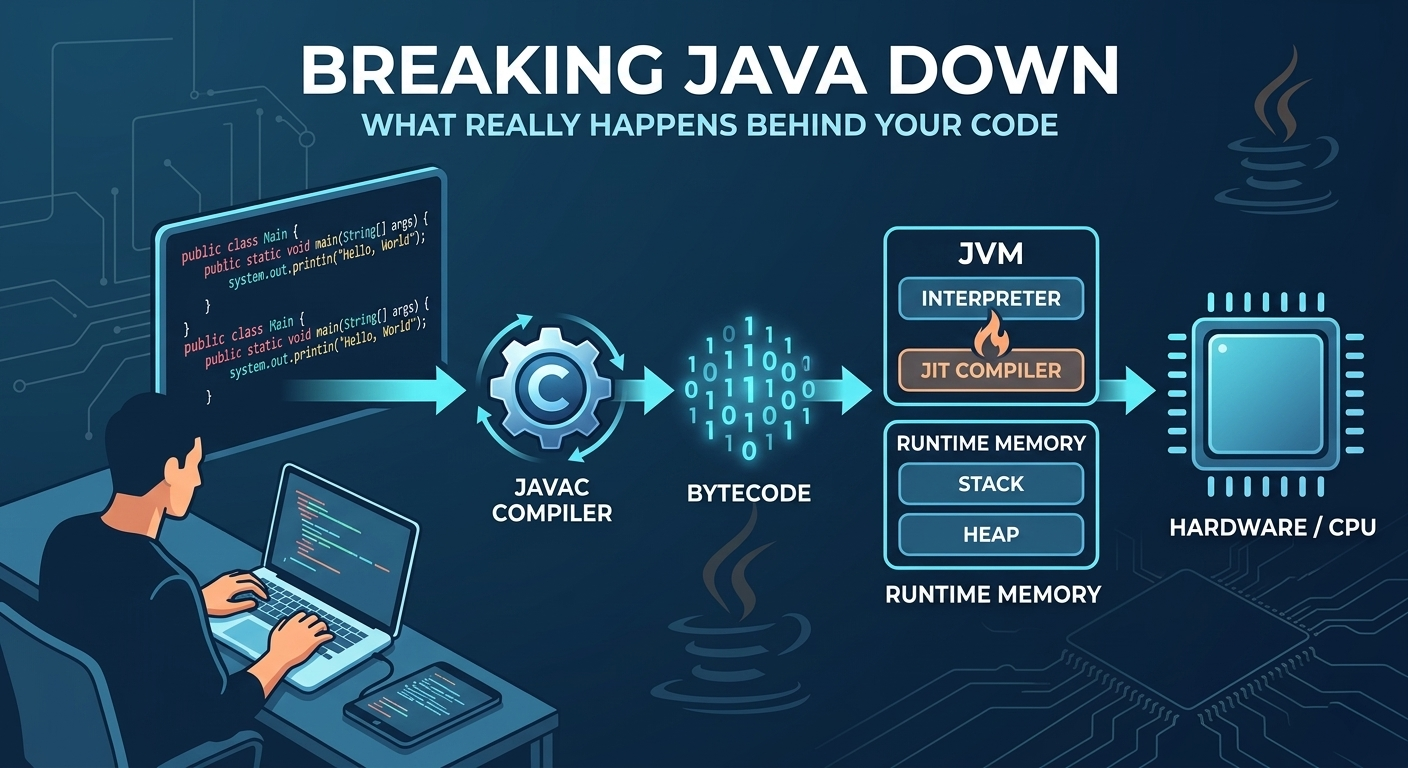
It looks tiny, almost trivial, but behind it, there’s a pipeline quietly doing a lot of work. Your code doesn’t go straight to the CPU. First, it gets translated into something called bytecode — a format designed not for your machine, but for the JVM. Then the JVM steps in and inspects it., verifies it and prepares it.
Before your program even runs, the JVM checks:
- “Is this code safe?”
- “Is memory being accessed correctly?”
- “Are there illegal operations here?”
Only after that does execution begin. Now comes the interesting part.
When int x = 10 runs, the JVM creates a space for x inside a stack frame — a small, fast memory region tied to the current method.
And unlike objects, this 10 isn’t stored somewhere else. It lives right there, direct, immediate and no indirection.
At the same time, the JVM is deciding how to execute your code. Initially, it may interpret it line by line, but if it notices that this code runs frequently, it might compile it into native machine instructions using the JIT compiler.
So the same line of code can actually be executed in different ways depending on runtime behavior. That’s a level of dynamism most developers never think about and yet, it’s happening all the time.
Why It Works This Way
None of this is accidental. Java was designed at a time when running the same program across different machines was a nightmare, different hardware, operating systems and behavior.
Java’s answer was bold “Let’s not run code directly on the machine but run it inside a controlled environment.” That environment is the JVM. It acts like a contract between your code and the machine. Because of that, Java can:
- Run the same program on different systems
- Prevent unsafe memory access
- Optimize code during runtime
But there’s a trade-off, you don’t get direct control anymore but you get managed behavior. And that management is exactly what keeps things stable at scale.
What Would Break Otherwise
Now imagine removing all of this, no JVM or verification or managed memory. Your Java code becomes something closer to C. At first, it might feel powerful with more control, more direct execution.
But then the cracks start showing. A small mistake could overwrite memory you don’t own. A dangling reference could crash your entire application. Two environments could run the same code differently. And suddenly, debugging becomes guesswork. The kind where “It works on my machine” becomes your daily reality.
Java avoids that chaos by taking control away from you, on purpose.
Back to Real Engineering
This isn’t just about curiosity. This is where real engineering starts to separate from surface-level coding. When your service suddenly slows down in production, it’s not enough to say “The code looks fine.” You need to understand:
- What’s happening in memory
- How objects are being allocated
- When the JVM decides to optimize or not
When debugging strange issues, the answers often live below your code. Not in what you wrote but in how it’s being executed.
Closing Insight
Java didn’t make complexity disappear, it buried it under layers of abstraction and for most developers, that’s enough.
But if you’re the kind of engineer who wants to understand why things behave the way they do then those layers are exactly where you need to look. This series is about peeling them back, slowly and carefully until things that once felt “automatic” start to feel intentional.
Because the moment you see what’s really happening under the hood you stop writing code blindly and start writing it with awareness.
Welcome to Breaking Java Down.

No posts yet